






Rebalancing restores a chosen allocation
When holdings move at different rates, the portfolio drifts from its target. Rebalancing brings it closer to that target; it does not establish that the target itself is suitable.
An AI agent can calculate drift, inspect cash and propose trades. You still need to specify the target, when to review it and how much movement matters. The SEC’s allocation guide explains rebalancing and the role of costs and taxes.
A $10,000 example
Assume a hypothetical portfolio has a 60% stock / 40% bond target, but now holds $6,800 in stocks and $3,200 in bonds. Ignoring fees, taxes and price movement during execution:
| Allocation | Now | Target | Change |
|---|---|---|---|
| Stocks | $6,800 · 68% | $6,000 · 60% | −$800 |
| Bonds | $3,200 · 32% | $4,000 · 40% | +$800 |
Selling $800 of stocks and buying $800 of bonds restores the target. New cash directed to the underweight side can instead reduce the need to sell. The 60/40 mix is an arithmetic example, not a recommendation.
Specify a schedule and a threshold
Review this allocation monthly. Compare current weights with my stated targets. Propose a rebalance only when an asset class is more than five percentage points away. Consider available cash before sales, and explain turnover and any missing tax information.
Five percentage points means a 60% target reaching above 65% or below 55%, not a 5% relative change. Precise wording avoids a surprisingly different trading rule.
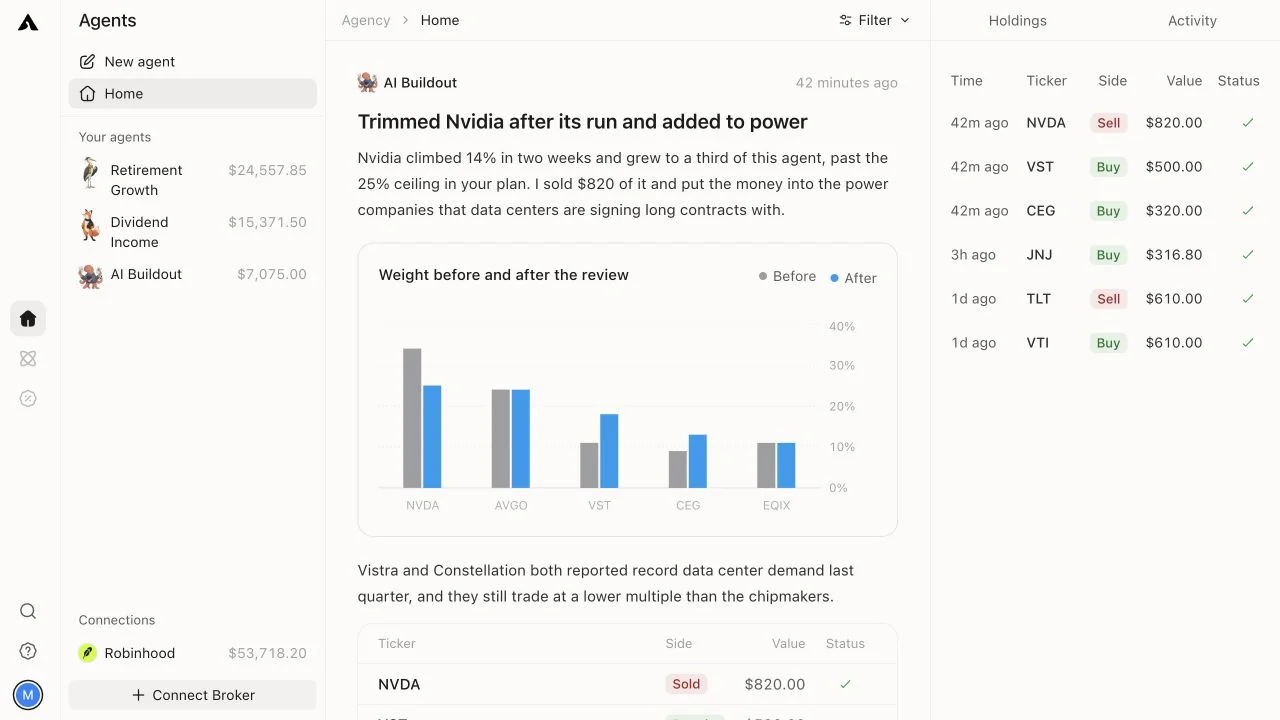
What to verify in Agency
Put targets and review frequency in the plan. Agency enforces the agent’s available cash and holdings; allocation percentages written in a plan remain instructions to the model. They are not guaranteed, continuously enforced limits.
Ask why a trade is necessary, especially in a taxable account. Rebalancing can reduce an unwanted concentration while also creating a tax bill. See the tax and records guide.