






Start with one job
You can use AI to research stocks, review holdings, prepare an order or manage an allocation. Those are different levels of access. Start by deciding which job you want done.
For research, you need reliable sources. For trades, you also need a supported broker connection and permission to submit orders. For recurring decisions, you need a service that actually runs the agent on a schedule.
A practical first session
- Ask an analysis-only question
Try: “Review my portfolio for concentration. Use current holdings and dated sources. Do not place orders.” Check that the account, quantities and prices match your broker.
- Choose the right workflow
A connected assistant suits individual questions and orders. A scheduled agent suits an ongoing plan. If you only want the same ETF purchase every payday, a broker’s recurring buy may already do the job.
- Define a budget and a plan
Use money you can afford to put at risk. Describe the goal, time horizon, permitted investments and review frequency. Ask which limits are enforced by software and which are instructions the model must follow.
- Inspect the proposed allocation
Check every holding against the plan. Look for overlapping funds, concentrated positions and assumptions about money you need soon. A confident explanation does not resolve those problems.
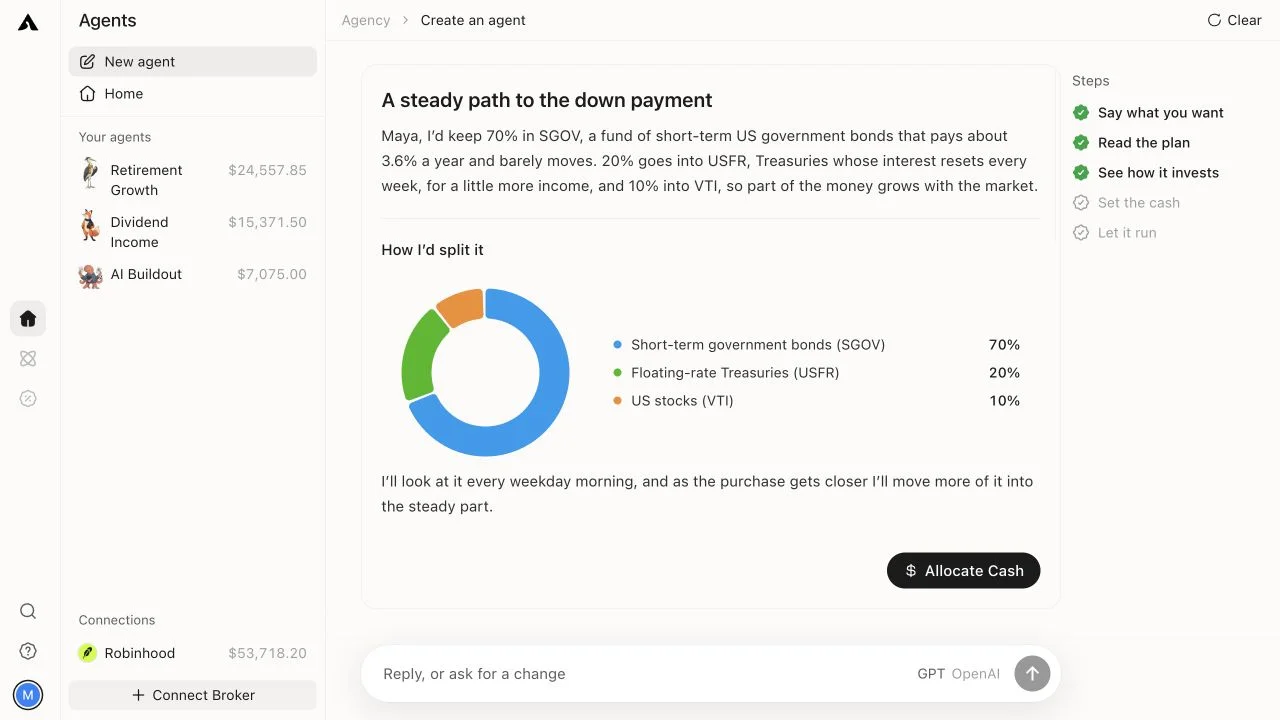
If you use Agency
Agency connects Robinhood and Public, and its agents trade stocks and ETFs. Create a plan, read the first look, then assign cash or holdings. Each funded agent reviews on its schedule and can trade without asking you to approve each order.
Keep the first allocation small enough that you can learn from a mistake. Check the next reviews against both the plan and the broker’s order history. More activity is not evidence of better management.
Follow the Agency setup guide, or start with an analysis-only portfolio review.